The Western Cemetery has attracted scholarly and exploratory attention since the early nineteenth century, yet systematic, publication-grade excavation has been episodic and incomplete. Political upheavals, funding gaps, and the sheer scale of the site have repeatedly halted progress.
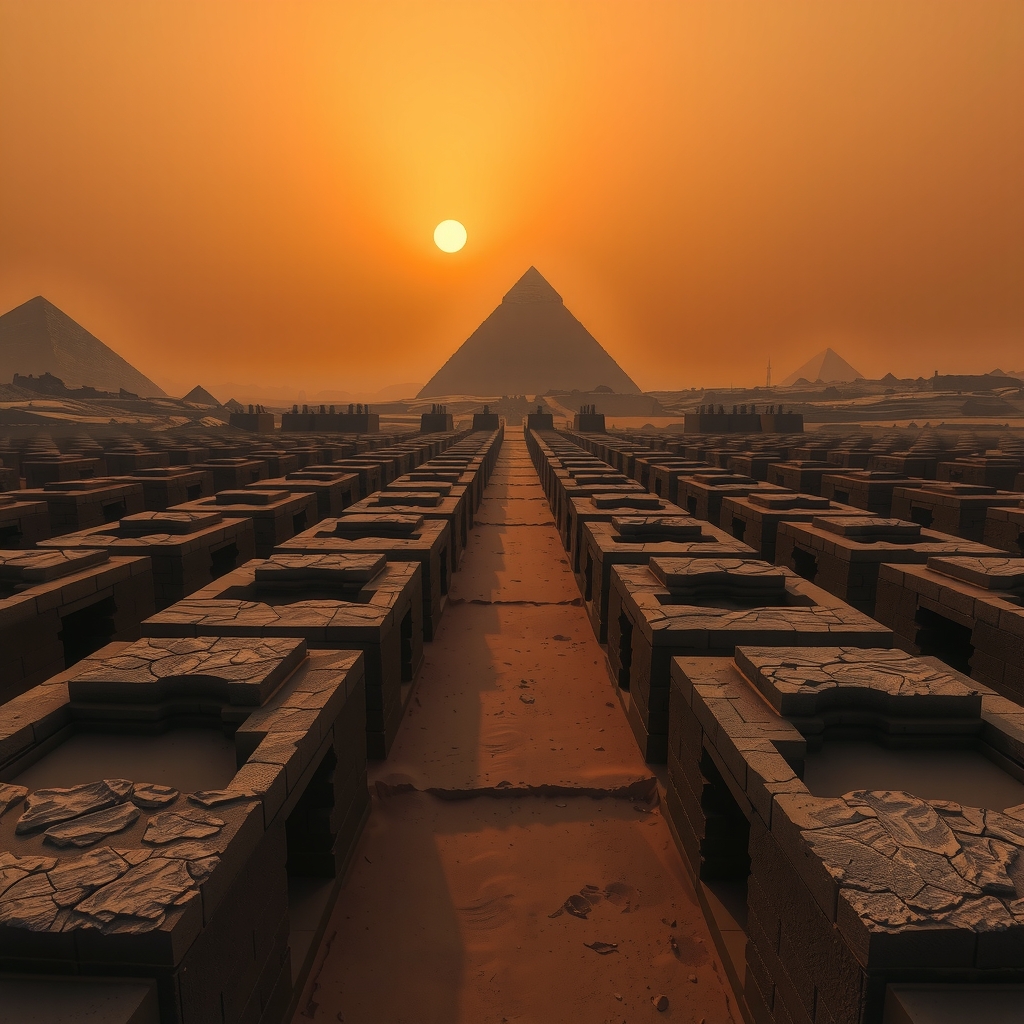
Active Research Site · Giza, Egypt
Giza Plateau
Giza Plateau
Western Cemetery
Tombs Still Sealed Beneath the Sand
Hundreds of mastaba tombs lie largely unexcavated west of the Great Pyramid — an aristocratic necropolis that may reshape our understanding of Old Kingdom Egypt.
Overview & Significance
An Aristocratic City of the Dead
The Western Cemetery of the Giza Plateau is one of the largest and most important Old Kingdom burial grounds in Egypt, stretching across the desert plateau west of the Great Pyramid of Khufu. Arranged in deliberate, grid-like rows, this necropolis was reserved for members of the royal family, high officials, and court elites during the Fourth and Fifth Dynasties.
Despite over a century of intermittent excavation, the vast majority of the cemetery's estimated 600–1,000 mastaba tombs remain uncleared, unstudied, or only partially documented. Sand encroachment, bureaucratic access restrictions, and funding shortfalls have left entire tomb clusters sealed — their wall paintings, inscriptions, funerary goods, and skeletal remains undisturbed since antiquity.
What remains beneath may not merely be secondary burials. Several tomb superstructures identified through ground-penetrating radar surveys suggest chambers of significant scale, potentially housing intact assemblages that could yield extraordinary historical data on Old Kingdom social structure, religion, and material culture.
600+Identified Mastaba Structures
~70%Estimated Still Unexcavated
4th–5thDynasty Royal Necropolis
c. 2550 BCEApproximate Construction Begins
Research Intelligence
What Lies Beneath
Multiple lines of evidence — from archival surveys to modern non-invasive remote sensing — suggest the unexcavated portions of the Western Cemetery hold significant archaeological deposits. Here is what the current evidence points toward.
⬛
Sealed Mastaba Chambers
Dozens of mastaba tombs retain intact mudbrick and limestone superstructures with sealed shafts. Several have never been entered in the modern era. Ground-penetrating radar and resistivity surveys have detected subsurface voids consistent with unlooted burial chambers containing organic and material remains.
𓂀
Decorated Chapel Interiors
Known excavated mastabas — such as those of Nefermaat and Rahotep — have yielded extraordinarily preserved relief carvings and painted scenes of daily life. Unexcavated tombs of comparable scale likely contain similar programmes, potentially in better condition due to centuries of sand protection.
⚱
Funerary Assemblages
Fourth Dynasty elite burials have produced canopic jars, statuary, model tools, furniture inlays, and jewelry. Even tombs previously entered by early explorers may have intact secondary chambers below silt infill. The probability of organic material survival — wood, linen, papyrus — is elevated by the plateau's arid microclimate.
🦴
Bioarchaeological Data
The workers' cemetery discovered by Hawass in 1990 transformed our understanding of pyramid builders' lives. The untouched elite tombs of the Western Cemetery could yield equally transformative osteological data — diet, disease, age, kinship — reframing Old Kingdom court demography.
📜
Epigraphic Records
Tomb inscriptions from this period record titles, genealogies, and administrative functions that function as primary historical documents. Hundreds of undocumented tombs may contain texts that fill conspicuous gaps in the prosopographical record of the Fourth and Fifth Dynasties.
📡
Sub-surface Anomalies
Recent magnetometry surveys conducted near the western field's southern edge have returned anomalous readings suggestive of large, deep architectural features not corresponding to any mapped tomb. Their nature — whether additional shafts, subterranean corridors, or a previously unknown structure — remains unexplained.
Archaeological History
Past Digs & What Was Found
1837–42
Colonel Howard Vyse & John Perring
First systematic documentation of Giza tombs using measured survey drawings. Identified the grid layout of the western field but entered few tombs. Published results in Operations Carried on at the Pyramids of Gizeh.
1902–32
George Reisner — Harvard-MFA Expedition
The most systematic excavation of the western field to date. Reisner documented and cleared hundreds of tombs, producing meticulous records. Yet even he acknowledged that time and resources prevented full clearance — and his unpublished notebooks remain a significant trove of unreleased data at the MFA Boston.
1925
Discovery of Hetepheres I — Tomb G 7000X
A chance discovery by Reisner's photographer led to the tomb of Queen Hetepheres I, mother of Khufu, in the western field's eastern edge. Despite robbery in antiquity, the tomb contained a sealed canopic chest and a remarkably complete funerary assemblage. A reminder of what sealed contexts preserve.
1990
Hawass & Lehner — Workers' Village
Adjacent to the western cemetery's southern perimeter, the discovery of pyramid builders' settlement and cemetery offered revolutionary bioarchaeological data. Excavations remain ongoing and demonstrate how much can still be found with systematic modern methods.
2009–pres.
AERA & ScanPyramids Remote Sensing
Non-invasive surveys using ground-penetrating radar, muon tomography, and magnetometry across and adjacent to the western field have produced anomalous subsurface readings. Results are partially published, sparking ongoing debate about unexplored features.
Scholarship & Primary Sources
Key Citations & Sources
- [1]Reisner, G.A. (1942). A History of the Giza Necropolis, Vol. I. Harvard University Press.
- [2]Reisner, G.A. & Smith, W.S. (1955). A History of the Giza Necropolis, Vol. II: The Tomb of Hetep-heres the Mother of Cheops. Harvard University Press.
- [3]Lehner, M. (1997). The Complete Pyramids. Thames & Hudson. pp. 112–127.
- [4]Hawass, Z. & Lehner, M. (1997). "Builders of the Pyramids." Archaeology, 50(1), pp. 30–38.
- [5]Strudwick, N. (1985). The Administration of Egypt in the Old Kingdom. KPI, London.
- [6]Morishima, K. et al. (2017). "Discovery of a big void in Khufu's Pyramid by observation of cosmic-ray muons." Nature, 552, pp. 386–390. doi:10.1038/nature24647
- [7]Ancient Egypt Research Associates (AERA). (2023). Field Reports: Giza Plateau Mapping Project. aera.com.eg (accessed 2024).
- [8]Porter, B. & Moss, R.L.B. (1974). Topographical Bibliography of Ancient Egyptian Hieroglyphic Texts, Reliefs, and Paintings, Vol. III: Memphis. Griffith Institute, Oxford.
Interactive Timeline
From Construction to Today
c. 2551–2528 BCE
Reign of Khufu — Western Field Begins
The western cemetery begins to be laid out as a planned royal necropolis, with tombs assigned to family members and high officials in a regularized grid corresponding to the Pyramid complex.
c. 2494–2345 BCE
Fifth Dynasty Expansion
The necropolis continues to expand under Fifth Dynasty rulers, with new tomb clusters added south and west of the Fourth Dynasty core. Tomb inscriptions become more elaborate, incorporating biographical texts.
c. 2150 BCE
Cemetery Falls Out of Use
With the collapse of the Old Kingdom at the end of the Sixth Dynasty, the western field ceases to receive new elite burials. Some reuse occurs in later periods, but the core necropolis is effectively abandoned.
1837
Vyse & Perring Survey
First measured documentation of the western field's layout. The grid of mastabas is recorded but largely not entered. Many tomb openings are noted as blocked with ancient blocking stones or sand.
1902
Reisner Begins Harvard-MFA Excavation
George Reisner begins three decades of systematic excavation, establishing the site's scholarly framework. Thousands of objects are recovered; the excavation archive is the most comprehensive of any Giza dig.
1925
Hetepheres Tomb Discovery
The accidental find of Queen Hetepheres I's tomb demonstrates that extraordinary intact deposits survive on the plateau. The tomb yields gold furniture fittings and a sealed canopic chest.
1990
Workers' Necropolis Identified
Hawass and Lehner discover the pyramid builders' village and cemetery immediately south of the western field's perimeter, opening a new chapter in Giza research.
2015–2017
ScanPyramids & Muon Tomography
International team deploys cosmic-ray muon detectors, confirming a previously unknown void within the Great Pyramid. Western cemetery subsurface anomalies noted in GPR survey data.
2023–Present
AERA Ongoing Mapping
AERA's Giza Plateau Mapping Project continues to refine site documentation. Several unexcavated tomb clusters in the western field's southern sector are prioritized for future investigation pending permits.
Join the Research
Know a Site That Should Be Here?
Our database grows through researchers, fieldworkers, historians, and curious minds worldwide. If you know of an unexcavated, under-documented, or overlooked site that deserves a record — submit it.
Submit a SiteFrequently asked questions
How many tombs are in the Giza Plateau Western Cemetery, and how many remain unexcavated?
The Giza Plateau Western Cemetery contains an estimated 600 to 1,000 mastaba tombs. Approximately 70% of these are still considered unexcavated, uncleared, or only partially documented. Sand encroachment, bureaucratic access restrictions, and funding shortfalls have left entire tomb clusters sealed and undisturbed since antiquity.
Who was buried in the Western Cemetery, and when was it built?
The Western Cemetery was reserved for members of the royal family, high officials, and court elites during the Fourth and Fifth Dynasties of the Old Kingdom. Construction is estimated to have begun around 2550 BCE, with the cemetery in use through approximately 2150 BCE. The tombs were arranged in deliberate, grid-like rows west of the Great Pyramid of Khufu.
What is the most significant discovery ever made in the Western Cemetery?
In 1925, a chance discovery by George Reisner's photographer uncovered Tomb G 7000X, belonging to Queen Hetepheres I, mother of Khufu. Despite ancient robbery, the tomb contained a sealed canopic chest and a remarkably complete funerary assemblage, demonstrating the extraordinary preservation potential of sealed contexts within the cemetery.
What methods are being used to investigate the unexcavated areas without digging?
Non-invasive remote sensing techniques including ground-penetrating radar, resistivity surveys, magnetometry, and muon tomography have been applied across and adjacent to the western field. These surveys have detected subsurface voids consistent with unlooted burial chambers and anomalous readings near the southern edge suggesting large, deep architectural features not corresponding to any mapped tomb.
What kind of historical information could unexcavated tombs in the Western Cemetery reveal?
Unexcavated Western Cemetery tombs could yield tomb inscriptions recording titles, genealogies, and administrative functions that fill gaps in the historical record of the Fourth and Fifth Dynasties. Intact burial chambers may also contain funerary goods, decorated chapel interiors, and skeletal remains providing bioarchaeological data on diet, disease, and kinship among Old Kingdom court elites.